
Wayne County Clerk Office
In Wayne County, the court clerk is the Clerk of Superior Court. North Carolina does not use a separate county clerk for trial-court case files. The Clerk of Superior Court maintains records for Superior Court and District Court, receives filings, processes payments, keeps case indexes, issues certified court copies, and handles estates and special proceedings. The Wayne County public-records page states the local routing plainly: all court records are maintained by the Wayne County Clerk of Court, including divorce records, criminal records, civil records, and traffic violation court records.
The clerk's public counter is at the Wayne County Courthouse, 224 E. Walnut St., Room 230, Goldsboro, NC 27530. The main phone number is (919) 722-6100. Public office hours are Monday through Friday, 8:30 a.m. to 5:00 p.m. The courthouse page says Clerk Whitfield asks visitors to arrive before 4:30 p.m. when opening new estates, making payments, or handling upset bids. Those matters can take longer than a simple copy question.
Wayne County Clerk of Superior Court
Wayne County Courthouse
224 E. Walnut St., Room 230
Goldsboro, NC 27530
(919) 722-6100
Monday-Friday, 8:30 a.m.-5:00 p.m.
Wayne County Clerk Duties
The North Carolina Judicial Branch describes clerks of superior court as elected officers responsible for clerical and record-keeping functions. In Wayne County, that role covers both Superior Court and District Court files because the trial courts are part of one statewide General Court of Justice. The clerk is also the ex officio judge of probate, which places estates and many special proceedings in the same office as court case records.
The G.S. 7A-109 clerk record-keeping statute is the state law source assigned to the clerk page.
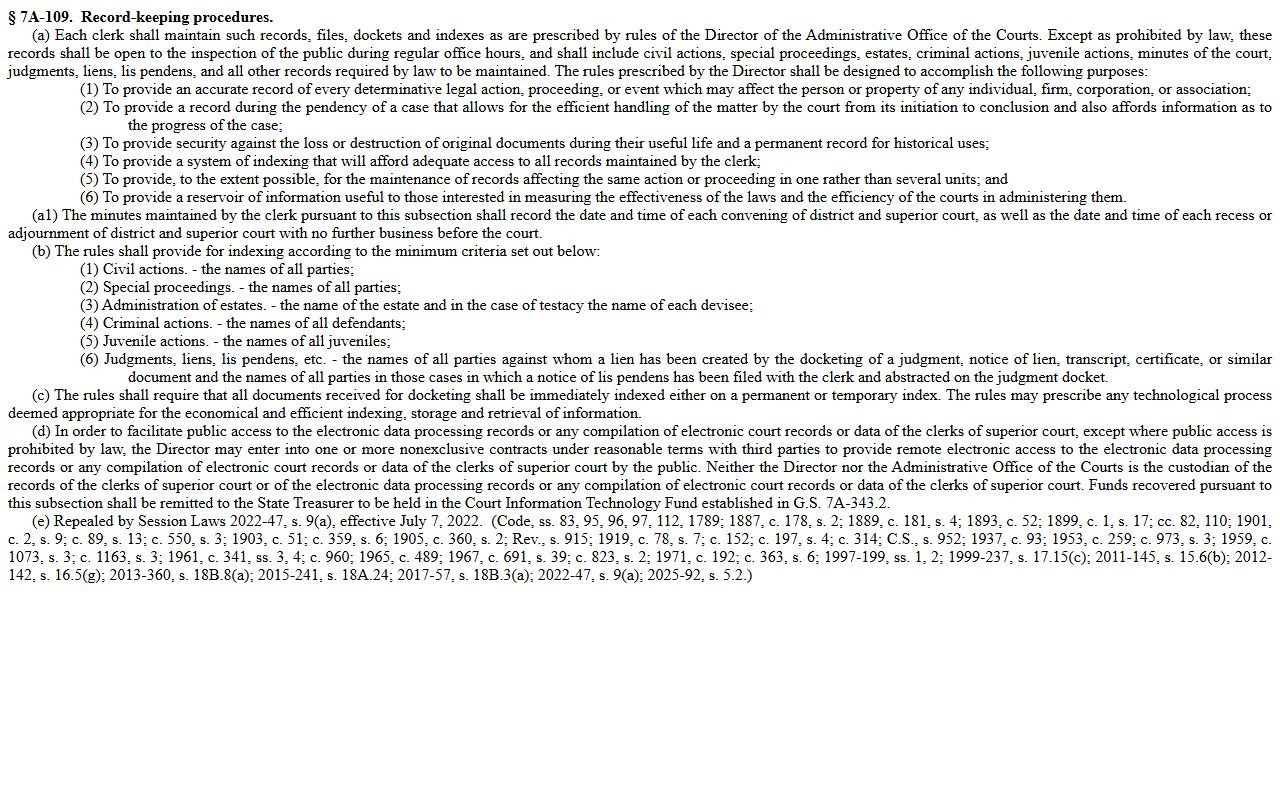
That statute supports the clerk's role in maintaining indexes and court records that feed public case search and judgment lookups.
- Maintain Superior Court and District Court case files for Wayne County.
- Process filings, pleadings, judgments, orders, notices, and other court papers.
- Issue plain and certified copies when public access and fee rules allow.
- Receive eligible traffic and court payments, including mail payments that meet county rules.
- Handle estates, guardianships, incompetency matters, foreclosures, partitions, and other special proceedings.
- Route unit-specific questions through civil, criminal, domestic, estates, jury, juvenile, bookkeeping, and special proceedings contacts.
Wayne County Clerk Records
Court records held by the clerk include civil lawsuits, higher-value Superior Court civil matters, District Court civil matters, small claims appeals, criminal files, traffic and infraction files, domestic and divorce judgments, estates, guardianships, and special proceedings. A case file may include complaints, summonses, motions, answers, orders, judgments, notices, citations, warrants, indictments, bonds, payments, or docket events depending on the case type.
The Register of Deeds is a different office. Marriage licenses, certified marriage copies, deeds, real estate instruments, assumed business names, notary oaths, and certain vital-record requests route to the Register of Deeds at 224-226 E. Walnut Street, Suite 100. That distinction prevents a common records mistake: the Wayne County Clerk of Superior Court is the source for divorce judgments, but the Register of Deeds is the source for Wayne County-issued marriage copies.
For a broader case search route, use the Wayne County court records page before requesting copies from the clerk.
Request Wayne County Certified Copies
A certified copy is a court copy that carries official certification from the clerk. It is often needed for legal use, appeals, agencies, name changes, proof of divorce, or filing in another proceeding. Start by finding the case number if possible. The statewide portal may help with case information, but the clerk is the right office when the record must be certified, older, non-online, or pulled from a local file.
- Identify the case type: civil, criminal, traffic, domestic, divorce, estate, or special proceeding.
- Search Portal or collect party names, approximate filing date, and case number if known.
- Contact the Wayne County Clerk of Superior Court or visit Room 230 with the record details.
- Ask whether the document is public, whether certification is available, and what fee applies.
- Pay through an accepted method and confirm whether pickup, mail, or another delivery option is available.
Note: The research did not locate a Wayne-specific certified-copy fee line, so verify copy costs before ordering.
Wayne County Request Fields
The official Judicial Branch public-record routing page points criminal, civil, estates, and special proceedings case information to Search Portal or the clerk. For a practical clerk request, the most useful fields are the ones that let staff identify the case and the document requested. A request for "all records" is less useful than a request with party names, case type, case number, document name, and whether certification is needed.
| Field | Required | Notes |
|---|---|---|
| Case number | Helpful when known | Portal or prior court papers may show the number. |
| Party names | Yes | Use plaintiff and defendant, state and defendant, petitioner and respondent, or decedent name. |
| Case type | Yes | Civil, criminal, traffic, domestic, estate, or special proceeding. |
| Document requested | Yes | Judgment, order, citation, docket sheet, estate filing, or other record. |
| Certified or plain copy | Yes | Certification changes the fee and handling. |
| Requester contact | Recommended | Provide phone or email so staff can clarify the request. |
Wayne County Clerk Fees
Wayne County court fees depend on the type of case, filing, copy, payment, or proceeding. The research file located the current N.C. court-cost publication page but did not capture every dollar amount for civil, criminal, estates, special proceedings, or certified copies. It also located Wayne County traffic payment rules for mail payments. Eligible traffic payments by mail must be made by money order or certified check only, with no cash and no personal checks. Payment should be made payable to Wayne County Clerk of Superior Court and mailed to the courthouse address with the citation number when paying a traffic citation.
| Item | Amount or Status |
|---|---|
| Civil court costs | Varies by case type; use current N.C. court-cost publications |
| Criminal court costs | Varies by charge and case; use current N.C. court-cost publications |
| Estates court costs | Varies by estate or special proceeding; use current N.C. estates costs |
| Traffic citation payment | Varies by citation and offense; check Portal or clerk |
| Court certified or plain copy fee | Specific copy amount not captured in official research |
Wayne County Online Routing
Online case information for Wayne County runs through the North Carolina eCourts Portal rather than a county-built court database. Portal functions include Smart Search, Search Hearings, payments for some criminal and infraction cases, and NC Judgment Search. Portal access can require JavaScript, cookies, and recurring CAPTCHA checks. Registered or elevated access may differ from anonymous public access, and documents may be limited by case type, redaction, role, or court order.
The Judicial Branch public-record request page is the official routing source for court case information and other Judicial Branch records.
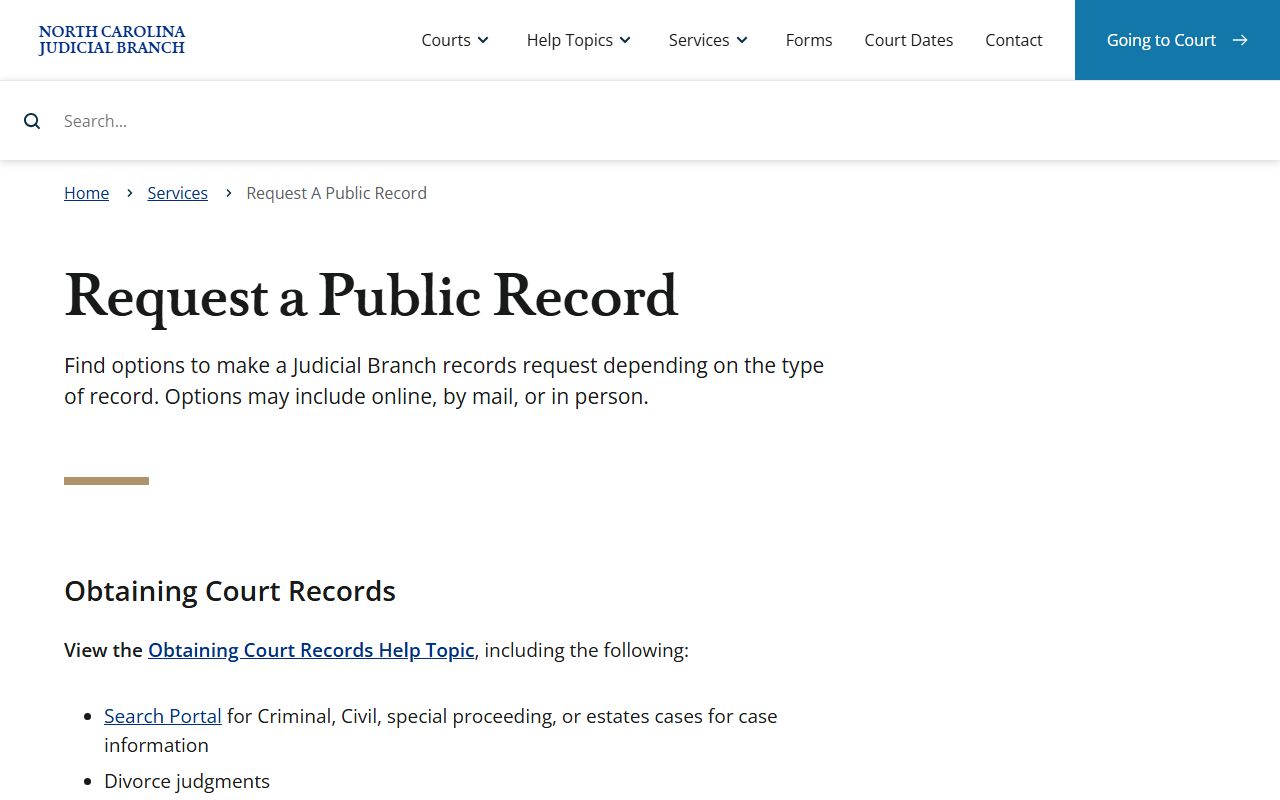
That routing page separates court case records from non-case Judicial Branch records and from county government records.
The Wayne County data and public-record request page applies to county government records, while court records still route to the clerk.
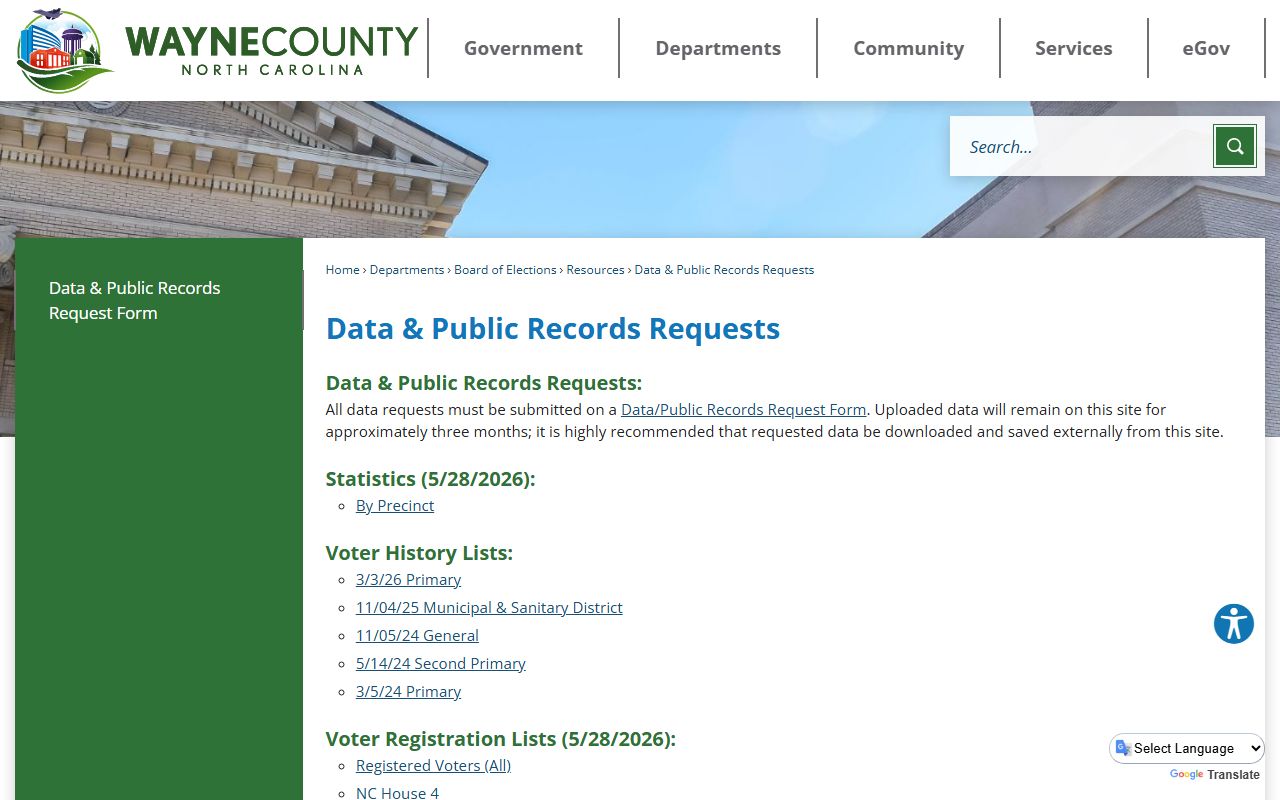
That county route helps distinguish county data requests from the Clerk of Superior Court's court-record files.
Wayne County Court Contacts
The Wayne County court contact directory lists the Clerk of Superior Court at (919) 722-6100 and also provides unit contacts for Superior Court judges, District Court judges, magistrates, District Attorney, bookkeeping, civil, criminal district, criminal superior, domestic, estates, jury, juvenile, and special proceedings. The public text harvested for the research did not expose all email addresses in machine-readable form, so the directory should be used directly when an email link is needed.
| Contact | Wayne County Role | Phone |
|---|---|---|
| Clerk of Superior Court | Court records, filings, copies, payments, estates | (919) 722-6100 |
| Superior Court Judges | Superior Court judicial chambers contact | (919) 722-6281 |
| District Court Judges | District Court judicial chambers contact | (919) 722-6250 |
| Magistrates | Initial appearances, warrants, small claims functions as assigned | (919) 722-6270 |
| District Attorney | Criminal prosecution and traffic-ticket questions for some citations | (919) 722-6200 |
Clerk Versus Register
The Wayne County Register of Deeds is not the Clerk of Superior Court. The Register of Deeds, listed with Tina Arnder as register in the research, records and indexes deeds, deeds of trust, satisfactions, powers of attorney, assumed business names, separation agreements, notary oaths, DD-214 military discharge recordings, and marriage licenses. The office's records go back to 1913, and most real estate records are online from 1971 forward. The Register also warns that the online version is not the official record and that the office cannot practice law or give drafting advice.
Use the clerk for court files, divorce judgments, estates, special proceedings, criminal cases, civil cases, and traffic violation court records. Use the Register of Deeds for marriage licenses, certified marriage copies, deeds, business and real estate recordings, and local vital-record services. When a record touches both offices, such as a separation agreement recorded by the Register and a later divorce judgment entered by the court, request each record from its own custodian.