
Wayne County Trial Courts
North Carolina uses a unified General Court of Justice rather than a county-by-county court system. In Wayne County, the primary trial courts are Superior Court and District Court. The current North Carolina Judicial Branch county listing places Wayne County in Prosecutorial District 9, Superior Court District 9B, and District Court District 9. Wayne County's courthouse is at 224 E. Walnut St., Goldsboro, NC 27530, and the Clerk of Superior Court is in Room 230.
Superior Court is the court of general jurisdiction. It hears felony criminal matters, civil cases at or above the state threshold, appeals from District Court in appropriate case types, and some matters tied to special proceedings. District Court handles misdemeanors, infractions, many traffic cases, juvenile matters, domestic cases, small claims appeals, and lower-value civil matters. The Wayne County Clerk of Superior Court is the unified record keeper for both courts.
The North Carolina District Court page is one official statewide source for District Court structure.
That statewide page helps place Wayne County District Court inside the larger North Carolina court system.
Wayne County Court Table
The research did not identify separate numbered county trial courts with distinct courthouse addresses. Instead, Wayne County's Superior Court and District Court sit within statewide districts and operate through the Wayne County Courthouse. The contact directory separately lists judges, magistrates, the District Attorney, and clerk units, while the Clerk of Superior Court remains the record office for case files.
| Court or Unit | Type | Address | Phone |
|---|---|---|---|
| Superior Court District 9B | Felony, higher civil, appeals from District Court | 224 E. Walnut St., Goldsboro | Judges (919) 722-6281 |
| District Court District 9 | Misdemeanor, infraction, traffic, domestic, juvenile, small claims | 224 E. Walnut St., Goldsboro | Judges (919) 722-6250 |
| Clerk of Superior Court | Records, filings, estates, special proceedings, payments | 224 E. Walnut St., Room 230, Goldsboro | (919) 722-6100 |
| Magistrates | Initial appearances, warrants, small claims functions as assigned | Wayne County court system | (919) 722-6270 |
| District Attorney | Criminal and juvenile prosecution for Greene, Lenoir, Wayne district | Wayne County court system | (919) 722-6200 |
Superior Court Versus District Court
Superior Court and District Court are not two county offices competing for the same file. They are trial-court levels inside one state court system. The Clerk of Superior Court maintains the records for both. Magistrates are judicial officers with assigned functions, but North Carolina does not have separate municipal trial courts for Goldsboro or other Wayne County cities in the way some states do.
| Issue | Superior Court | District Court | Magistrates |
|---|---|---|---|
| Main role | Felony, higher civil, District Court appeals | Misdemeanor, traffic, juvenile, domestic, lower civil | Initial process and assigned statutory duties |
| Civil matters | Generally higher-value cases and appeals | Lower civil matters and small claims appeal path | Small claims functions as assigned |
| Criminal matters | Felonies and appealed matters | Misdemeanors, infractions, first-level traffic cases | Warrants, orders, first appearances, bond-related duties |
| Record keeper | Clerk of Superior Court | Clerk of Superior Court | Clerk/court record systems where process is filed |
Search Wayne County Court Cases
Wayne County court case information is searched through the North Carolina eCourts Portal and related Judicial Branch tools, not through a standalone county database. Portal functions include Smart Search, Search Hearings, Make Payments for some criminal and infraction cases, and NC Judgment Search. The Wayne County Judicial Branch page links court dates and payment information, while the local schedules page links civil calendars, criminal calendars, District Court schedules, and search by case number, party, or attorney.
The Wayne County court dockets page is the closer match when the goal is a hearing date, calendar, or scheduled session rather than a full case file.
The Wayne County local administrative schedules page is assigned to this trial-court page in the image manifest.
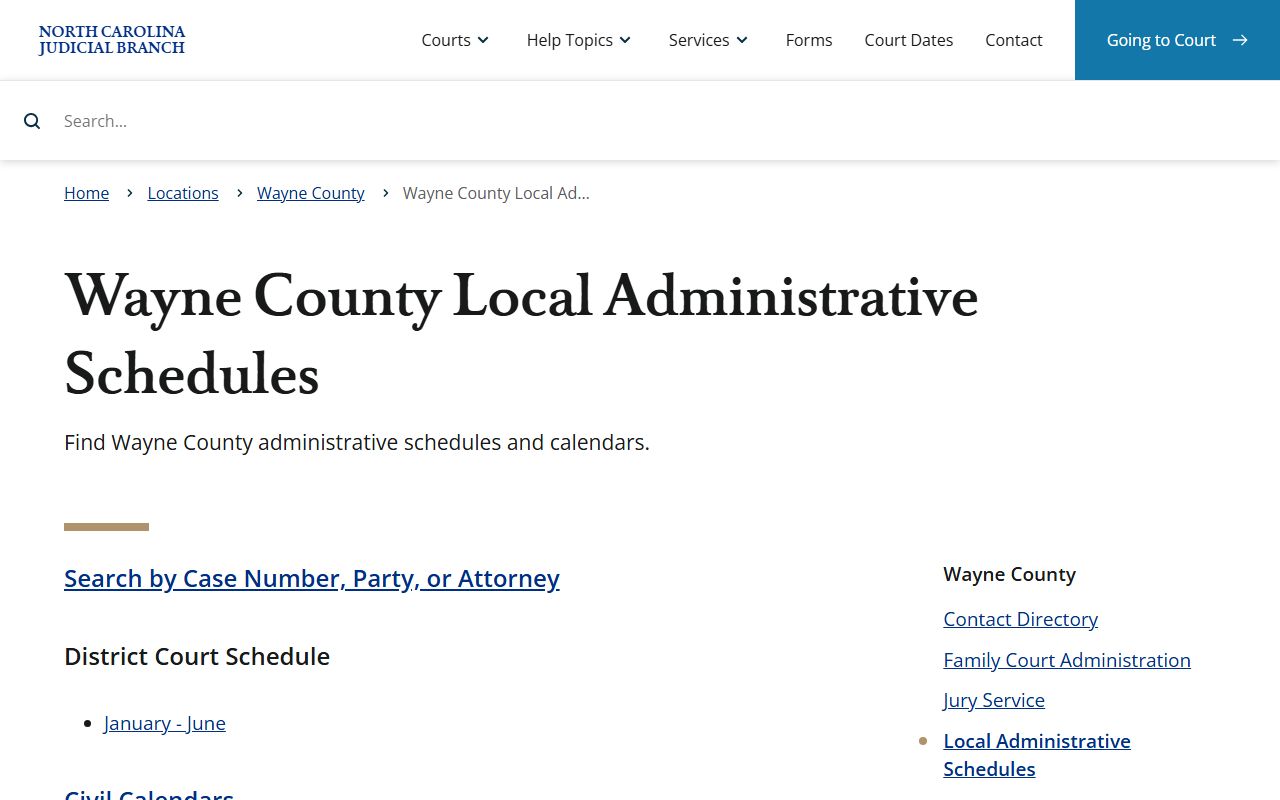
Those local schedule links help users move from a case search to the right calendar or court date resource.
- Start with Portal Smart Search for case information if the case number or party name is known.
- Use Search Hearings when the main need is a court date, citation number, or hearing calendar.
- Select Wayne County when a county filter is available.
- Check local administrative schedules for civil, criminal, and District Court calendar links.
- Contact the Clerk of Superior Court when the record is older, not online, unclear, or needed as a certified copy.
Wayne County Case Flow
Case movement depends on the type of case. A felony may begin with a magistrate process or District Court appearance and then move to Superior Court after indictment or transfer. A misdemeanor or infraction often remains in District Court unless appealed or connected to a felony matter. Civil cases depend on claim type and value. Domestic, juvenile, and many traffic matters are District Court matters.
Criminal flow: Charge or process › magistrate or first appearance › District Court setting › indictment or transfer for felony cases › Superior Court proceedings › plea or trial › judgment or sentence › appeal when allowed.
Civil flow: Complaint or petition filed › summons and service › answer or response › motions or mediation › hearing or trial › order or judgment › appeal when allowed.
Estate flow: Will or estate filing › clerk review › qualification when needed › inventory and accountings › creditor period and administration › closing documents.
Wayne County Local Rules
Local rules and forms matter because Wayne County operates inside judicial districts but still has local schedules, practice rules, and court administration documents. The current research flags local rules of bail and pretrial release for Judicial District 9-B, effective February 20, 2026, under both Superior Court and District Court. Those rules are especially relevant to criminal process, bond, orders for arrest, and pretrial release questions.
The Wayne County local rules and forms page is the official local rules source assigned to this page.
That source should be checked for updates before relying on older printed local practice materials.
Note: The North Carolina Judicial Branch county page should be treated as the current authority for district labels when it differs from older county background text.
Wayne County Domestic Cases
District Court handles domestic cases such as divorce, custody, child support, domestic violence protective orders, and related family matters. Divorce judgments are court records obtained from the Clerk of Superior Court in the county where the divorce was granted. Some domestic filings are public, but records involving minors, abuse, dependency, protected addresses, or sealed safety details may be restricted or redacted.
The N.C. divorce and marriage help topic is included in the district-court image set.
That help topic connects domestic court records with marriage, divorce, and certificate routing across court and vital-record offices.
The separation and divorce requirements page documents the North Carolina residency and separation rules.
Those requirements explain why a divorce record may not exist until filing, service, waiting periods, hearing, and judgment steps are complete.
Wayne County Divorce Packet
For absolute divorce filings, the North Carolina divorce packet process includes preparing forms, filing with the Clerk of Court, serving the defendant spouse, waiting 30 days, setting a hearing, and attending court with a prepared judgment for judge review. That process creates a District Court domestic case file. The final judgment is the record most often requested as proof of divorce, while the docket may also show filings, service, hearings, and orders.
The North Carolina divorce packet page is another assigned source for the Wayne County trial-court page.
That packet source is relevant to District Court because the filing steps create the local divorce court record.
Juvenile and Small Claims
District Court handles juvenile matters, domestic matters, misdemeanors, infractions, and many lower civil cases. Magistrates perform assigned duties, including small claims functions and initial criminal processes such as warrants or bond-related steps. Juvenile court records are not ordinary public records. North Carolina law restricts juvenile records except as allowed by statute or court order, so public search tools should not be expected to expose juvenile case details in the same way they expose adult civil or criminal matters.
Small claims records may include complaint forms, magistrate judgments, appeal notices, and writs. Appeals can move a matter from the magistrate level into District Court, and further appellate paths depend on the case type and order. A requester who only knows a party name should search Portal first, then contact the clerk if the small claims or juvenile-related record is unclear, restricted, or not online.
Wayne County Court Programs
Wayne County also has court programs and court-adjacent services that affect how cases move. The research identifies adult accountability and recovery programming serving the Wayne, Lenoir, and Greene footprint, a Family Accountability and Recovery Court model serving families affected by substance use or neglect, and a Wayne County Day Reporting Center designed to provide the court system with a one-point entry for offender services. These programs are not separate courts for public record searching, but they can appear in case supervision, treatment, review, and compliance contexts.
The Day Reporting Center is described as a county resource for community-based behavior management, reducing jail costs, reducing substance dependency, reducing recidivism, and providing education or employment programming. For records, that means program references may appear in orders or supervision conditions, while the case file itself still belongs with Superior Court, District Court, or the Clerk of Superior Court.
Wayne County eCourts Changes
Wayne County was part of the 2025 eastern North Carolina eCourts conversion. Judicial Branch news in April 2025 identified Wayne in Track 8 with other eastern counties, making Portal access, File & Serve, online payments, and hearing search central to current Wayne County court records. This explains why a newer Wayne County case may route through the statewide Tyler/eCourts environment instead of a legacy county portal.
Portal users should expect technical limits. JavaScript and cookies must be enabled. The Portal uses CAPTCHA checks, and card payment rules apply when paying eligible matters online. Public access can also depend on case type, user role, redaction, sealed status, and whether the case or document has been made available online. When the Portal does not answer the question, the Wayne County Clerk of Superior Court is the local fallback.